New York City was built by immigrants. Not as a metaphor, not as a political statement — as a simple, documented, historical fact. The Irish who dug the tunnels and laid the tracks. The Italians who built the bridges and the buildings. The Jews who ran the garment factories and the pushcart markets. The Chinese who built the railroads. The Puerto Ricans, the Dominicans, the West Indians, the Poles, the Ukrainians — every wave of newcomers added another layer to this city's impossible, magnificent story.
They came because they had no choice. They came because the alternative was starvation, persecution, or death. They came because someone told them that in America, if you worked hard enough, you could make something of yourself. And they believed it — even when the evidence was against them.
They were packed into tenements that were not fit for animals. They worked in factories for wages that barely covered rent. They faced discrimination in the workplace, in the schools, in the streets. And yet they stayed. And yet they built. And yet they fought.
The Great Waves
Who came, and when, and why
The Irish
1840s–1920s
The Irish came first, driven by the Great Famine of the 1840s. They settled in the Five Points, Hell's Kitchen, and the West Side. They built the city's infrastructure — the subways, the bridges, the police force, the fire department. The Irish dominated boxing in America for decades, producing champions from John L. Sullivan to Jack Dempsey. Their fighters were the first to show that an immigrant could be a hero.
The Jews
1880s–1924
More than two million Jews emigrated from Eastern Europe between 1880 and 1924, the vast majority settling in New York City. They fled pogroms, poverty, and the grinding discrimination of the Russian Empire. They packed into the tenements of the Lower East Side — the most densely populated neighborhood in the history of the world. And they built. And they fought.
The Italians
1880s–1930s
The Italians came from the impoverished south of Italy and Sicily, settling in East Harlem and the Lower East Side alongside the Jews. They worked in construction, in the garment trade, in the restaurants and the markets. Their fighters — Rocky Marciano, Jake LaMotta, Carmen Basilio — would become legends of the ring. In the gym, Italian and Jewish boys trained side by side.
African Americans
The Great Migration: 1910s–1970s
The Great Migration brought hundreds of thousands of Black Americans from the Jim Crow South to New York City, settling in Harlem and the Bronx. They faced the most severe discrimination of any group — and yet they produced some of the greatest fighters in boxing history. Sugar Ray Robinson, Floyd Patterson, Joe Louis. In the gym, they fought alongside everyone else. In the ring, they were equals.
The Boxing Gym as Democracy
The sociologist Thomas Jenkins traced the history of boxing in America and found a consistent pattern: the second generation of practically every urban immigrant group gravitated to boxing. The English, then the Irish, then the Jews, then the Italians, then the Black fighters, then the Hispanics. Each group used the ring as a ladder — a way to climb out of the ghetto and into something better.
But what made the boxing gym unique was not just that it offered opportunity. It was that it offered it to everyone, regardless of background. In the gym, the only currency was work. You could not buy your way to the top. You could not inherit a championship. You had to earn it, round by round, day by day, in the cold and the sweat and the pain.
This is why the boxing gym has always been New York's truest democracy. Not the democracy of the ballot box or the courtroom — those were often closed to immigrants. The democracy of the ring, where the only question was: how hard can you work?
"In a city teeming with immigrant communities — Irish, Italian, Jewish, African American, Puerto Rican — boxing became a vehicle for cultural expression, economic mobility, and the assertion of identity." — Boxing Insider
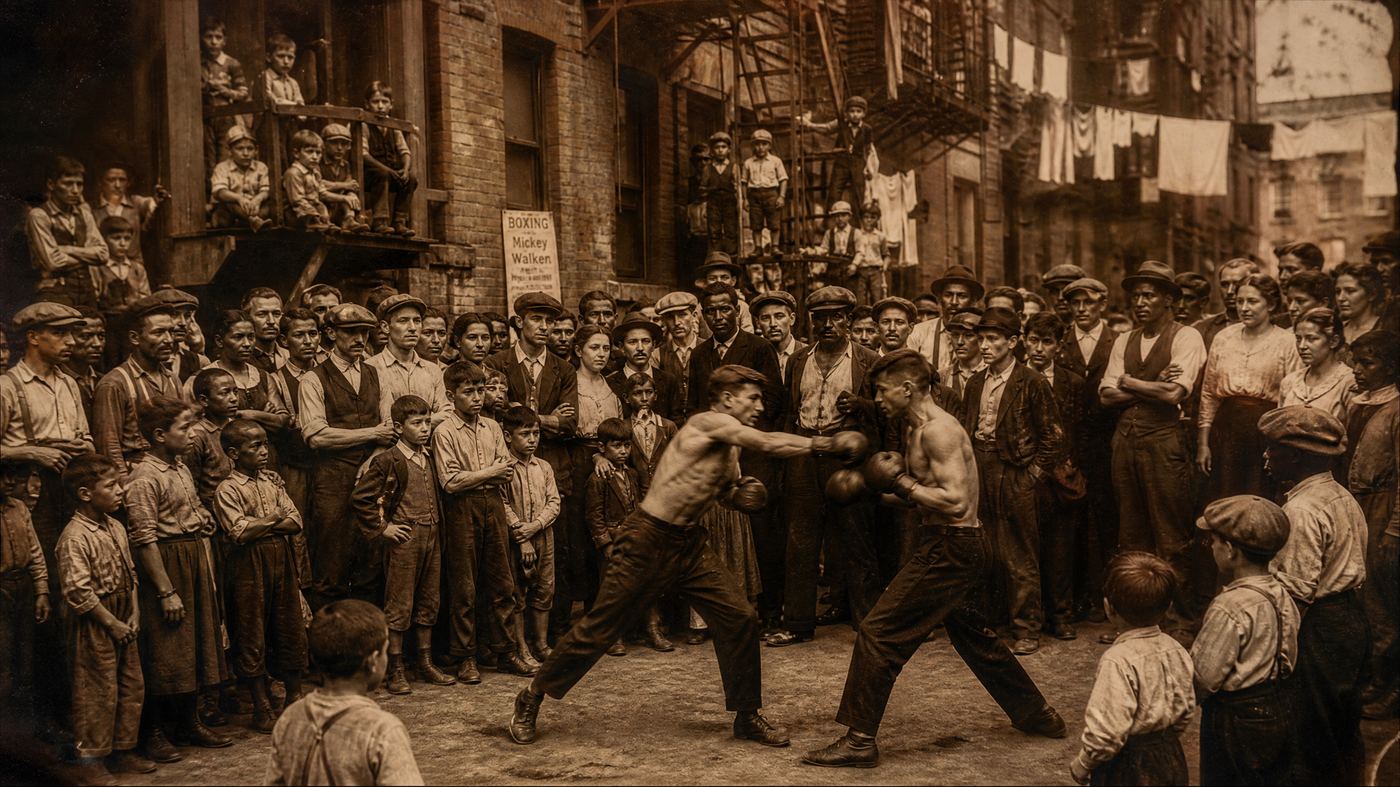
Orchard Street, Lower East Side — circa 1922
The Street Was the First Gym
Before there were gyms, there were streets. The boys of the Lower East Side learned to fight in the alleys and on the stoops, in the schoolyards and on the corners. They fought because they had to — because the neighborhood demanded it, because survival required it, because there was something in the air of New York City that said: stand up for yourself.
The boxing gym took that raw material — that street-forged courage and aggression — and shaped it into something disciplined and purposeful. A trainer with a flat cap and a pair of worn mitts could take a kid from Orchard Street and turn him into a professional fighter. Could give him a career, an identity, a future.
This is the story of New York. This is the story of America. And it is still being written today, in gyms across the five boroughs, by the sons and daughters of immigrants who are still fighting their way up.
Standing Together Today
The immigrant story of New York is not history. It is happening right now, in every borough of this city. And the challenges that immigrants face today — discrimination, poverty, the struggle to belong — are the same challenges that the Jews of the Lower East Side faced a century ago.
We built this website to honor those who came before us. But we also built it to say something about today. In a time when antisemitism is rising, when immigrants are being scapegoated, when the divisions in our society seem deeper than ever — we believe in the lesson of the boxing gym.
We believe that the man next to you in the gym is your brother. That it does not matter where he was born, what language he speaks, or what God he prays to. What matters is how hard he works, how much he cares, and whether he will be there when you need him.
New Yorkers stand together. That is who we are. That is who we have always been.