
NEW YORK CITY • SINCE 1880
NEW YORK
BOXING
COMMUNITY
They came with nothing.
They fought for everything.
A Tribute to the Immigrant Fighters of New York
Enter the Gym
NEW YORK CITY • SINCE 1880
They came with nothing.
They fought for everything.
A Tribute to the Immigrant Fighters of New York
Enter the GymToday, as antisemitism rises across the world and in our own city of New York, we remember what the Lower East Side taught us. We remember that the Jewish community of New York has always been part of the fabric of this city — not despite its immigrant roots, but because of them. The same courage that built this city is the courage we need today.
The boxing gym has always been a place where people of every background stand together. Where the man next to you is your brother, regardless of where he was born or what God he prays to. That is the New York we believe in. That is the New York worth fighting for.
This website is dedicated to every immigrant who ever came to this city looking for a better life. To every Jewish family that made New York their home. To every fighter who climbed through the ropes and showed the world what it means to be a New Yorker.
No matter the challenges — New Yorkers stand together and fight the good fight.
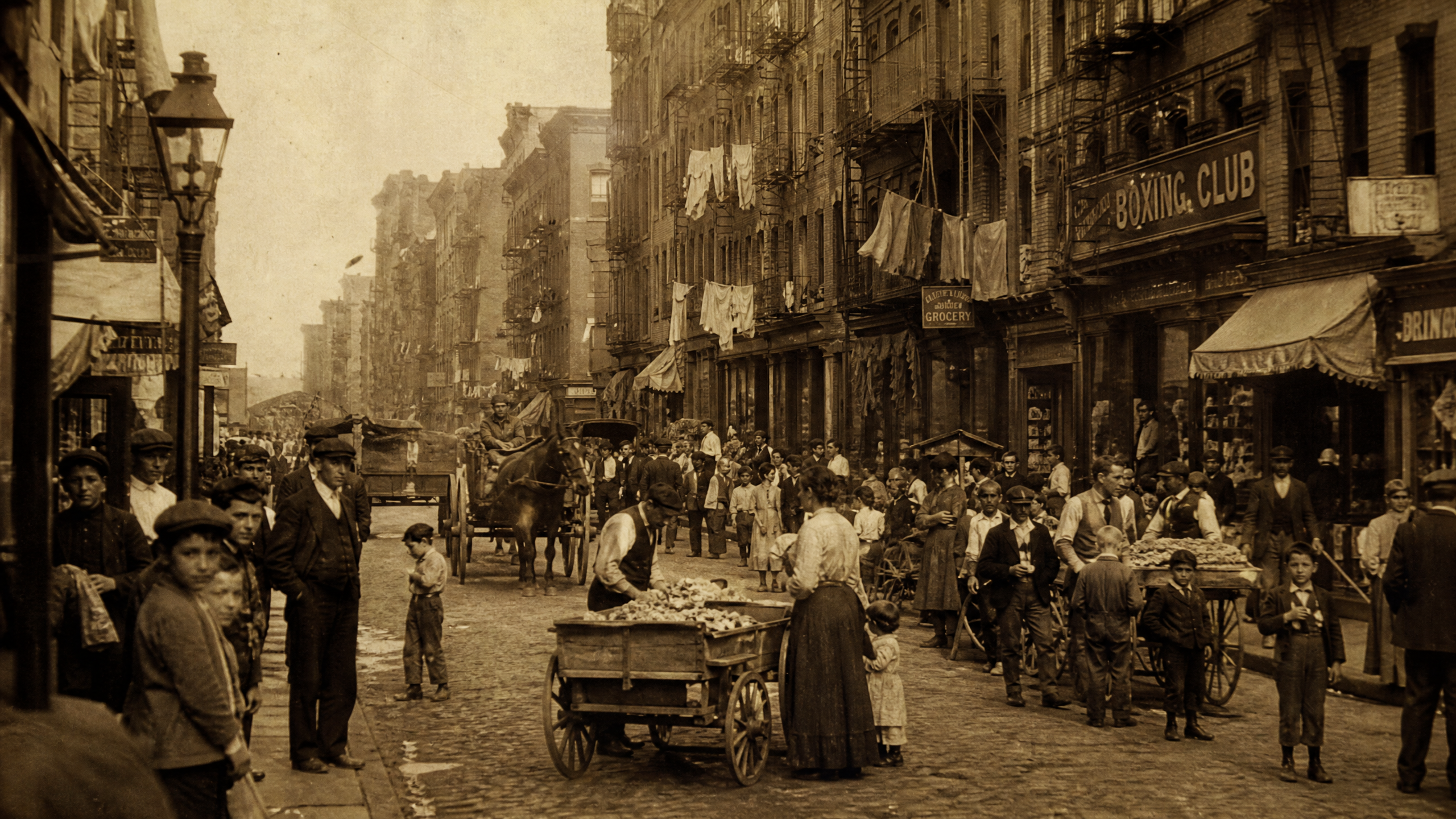

They came by the millions — from the shtetls of Eastern Europe, the villages of Sicily, the counties of Ireland, the towns of the American South. They arrived at Ellis Island with nothing but the clothes on their backs and the fire in their hearts. They were packed into the tenements of the Lower East Side, five families to a floor, no heat, no light, no future that anyone could see.
But New York does something to a person. This city demands that you fight. Not just in the ring — in the street, in the factory, in the school, in the courtroom. And for the young men of the Lower East Side, the boxing gym was the place where that fight became something beautiful. Something disciplined. Something that could take a boy from Orchard Street and put him in Madison Square Garden in front of fifty thousand people.
This website is a tribute to those men. To the Jewish fighters who wore the Star of David on their trunks and carried the hopes of an entire people into the ring. To the Irish boys from Hell's Kitchen who fought alongside them. To the Italian kids from East Harlem. To the Black fighters who broke every barrier placed before them. They were New Yorkers. They were Americans. And they fought together.
"In the gym, nobody cares where you came from. They only care how hard you work."
★ THE GOLDEN ERA ★
From 1910 to 1940, twenty-six Jewish world champions rose from the streets of New York and Chicago. By 1928, Jews were the dominant nationality in professional prizefighting in America. They wore the Star of David on their trunks with pride. They fought not just for themselves — they fought for every family crowded into a tenement, for every father who worked sixteen hours in a sweatshop, for every mother who prayed her son would make something of himself in this new world.
This was not an accident. This was New York. This was the immigrant spirit made flesh.
Meet the Fighters
The champions who rose from the Lower East Side
World Lightweight Champion
1917 – 1925
Born Benjamin Leiner on the Lower East Side, he became "The Ghetto Wizard" — perhaps the greatest lightweight of all time. Ray Arcel called him the best he ever trained. He held the title undefeated for nearly eight years.
Read More →World Champion — Three Divisions
1933 – 1938
Born Dov-Ber Rasofsky, he held world titles in three weight classes. A war hero at Guadalcanal, he killed 22 enemy soldiers while wounded, saying the Sh'ma. He was the last great Jewish champion.
Read More →World Light Heavyweight Champion
1932 – 1934
"Slapsie Maxie" — world champion with a clowning style that masked a brilliant boxing mind. 289 professional fights. A showman, a fighter, and a New Yorker through and through.
Read More →Lightweight Contender
1913 – 1928
The great southpaw from Philadelphia who challenged Benny Leonard twice, drawing 70,000 fans to Yankee Stadium. One of the most dangerous left-hand punchers of his era.
Read More →"The Jewel of the Ghetto"
Lightweight Contender, 1920s–1930s
A hard-punching welterweight from the Lower East Side who became one of boxing's most respected referees, officiating 39 world title bouts. The ghetto produced champions even in retirement.
Read More →World Featherweight Champion
1906 – 1912
"The Little Hebrew" — world featherweight champion for six years, losing only nine of 172 fights. A brilliant defensive boxer who inspired a generation of Jewish fighters to believe the ring was their arena.
Read More →
In the gyms of the Lower East Side, the Bronx, and Brooklyn, there were no ghettos. There were no neighborhoods. There was only the ring, the heavy bag, the speed bag, and the man across from you. Jewish boys trained alongside Italian boys. Irish fighters sparred with Black fighters. The gym did not care about your religion, your race, or where your parents were born.
This was the promise of America made real — not in the courts or the legislature, but in a sweaty room above a delicatessen on Delancey Street, under a single bare bulb, with a trainer in a flat cap watching from the corner.
The boxing gym has always been New York's truest democracy.
The Lower East Side Story
Orchard Street, Lower East Side — circa 1922
Between 1880 and 1924, more than two million Jews emigrated from Eastern Europe to the United States, the vast majority settling in New York City. They fled pogroms, poverty, and persecution. They arrived in a city that was not always welcoming — that had its own forms of discrimination, its own walls to climb.
But they climbed. They built. And their sons — the sons of tailors and peddlers and factory workers — found in boxing a way to prove something. Not just to the world, but to themselves. That they were strong. That they were brave. That they were American.
The boxing gym was where the immigrant story became the American story. And nowhere was that story more powerfully told than on the Lower East Side of Manhattan, in the years between the two World Wars.
The Immigrant Story
★ MADISON SQUARE GARDEN ★
Benny Leonard and Lew Tendler fought at Yankee Stadium before 70,000 fans. Barney Ross fought Jimmy McLarnin at Madison Square Garden as pro-Nazi rallies filled the streets outside. These were not just boxing matches. They were battles for dignity, for identity, for the right to belong.
The Jewish fighters of New York carried the weight of their people into the ring. And they did not flinch.
The Championship EraBehind every great fighter was a trainer who believed in him when no one else did. Ray Arcel, Whitey Bimstein, Freddie Brown — the great Jewish trainers of New York who shaped champions across every ethnic community. They did not ask what church you went to. They asked how hard you could work.
The corner of a boxing ring is one of the most intimate relationships in sport. A trainer sees everything — your fear, your courage, your character. And the great trainers of the Lower East Side era saw something in these immigrant boys that the rest of the world had not yet recognized: that they were extraordinary.
"Boxing is brains over brawn. I don't care how much ability you got, if you can't think you're just another bum in the park." — Ray ArcelThe Legacy

A trainer and his fighters — Lower East Side, circa 1934
How antisemitism built the most famous boxing gym in the world

Stillman's Gym — 919 Eighth Avenue, New York City • circa 1935
The story of Stillman's Gym — the most famous boxing gym in the history of the sport — begins not with a champion or a promoter, but with a drunk and a slur.
Before Stillman's, the premier fight gym in New York was Billy Grupp's, up on 116th Street in Harlem. Every serious fighter in the city trained there. Benny Leonard trained there. The best Jewish fighters in the world trained there. Until one night, after too much whiskey, Billy Grupp stood up and blamed the Jews for starting World War I.
"After a drunken, antisemitic tirade by Grupp, blaming the Jews for World War I, Benny Leonard and a contingent of Jewish fighters stormed out — and never came back."
Leonard and his men walked out that night and started looking for somewhere else to train. They found a storefront on 125th Street and Seventh Avenue — a modest space run by a man named Louis Ingber, a former trolley conductor hired by a wealthy philanthropist named Marshall Stillman to keep kids off the street. The place had almost no equipment. It wasn't built for professional fighters. But Benny Leonard said it would do.
Ingber — who would eventually take the name Lou Stillman — knew nothing about boxing. But he was smart enough to recognize what he had. He started charging the public fifteen cents to watch Leonard and the others train. Word spread. More fighters came. The greatest trainers in the sport followed — Ray Arcel, Whitey Bimstein, Charley Goldman, Freddie Brown.
By the time Stillman moved the gym downtown to 919 Eighth Avenue in the early 1930s — two blocks from Madison Square Garden — it had become the center of the boxing universe. Joe Louis trained there. Sugar Ray Robinson trained there. Rocky Graziano, Willie Pep, Jersey Joe Walcott. Frank Sinatra watched sparring from the front row. Marlon Brando came to prepare for On the Waterfront. Paul Newman came for Somebody Up There Likes Me.
All of it — every world champion, every great trainer, every legendary afternoon in that filthy, smoke-filled room — traces back to one night when a man said something hateful about the Jewish people, and Benny Leonard decided he didn't have to take it.
That is the New York story. That is the immigrant story. You get knocked down. You get back up. And you build something better.
A photographic record of the men who built New York boxing

A young man from Orchard Street steps into the gym for the first time. He has nothing but his hands, his hunger, and the fire that brought his family across an ocean. Within three years, he will fight at Madison Square Garden.

Jewish, Italian, Irish, Black — in this room, none of that matters. The trainer watches from the corner. The fighters learn from each other. This is the democracy the tenements never offered them. This is New York at its finest.
"The gym was the one place in the city where it didn't matter what your name was or where you came from. What mattered was whether you could fight."